R.Madhwal Veteran & Farmer
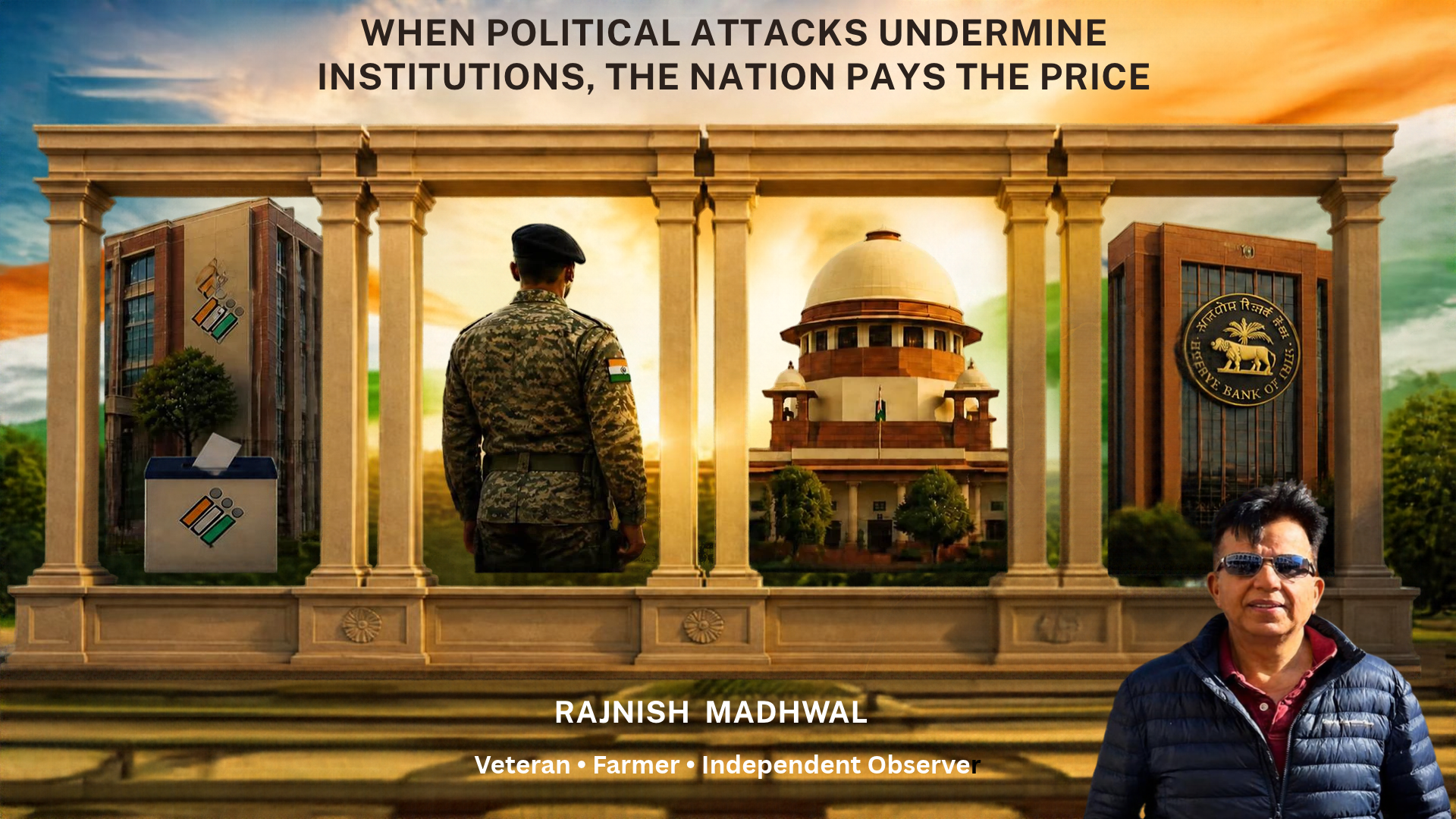
The true strength of a nation lies not merely in its leadership, but in the institutions that endure beyond individuals, governments and generations.
The Election Commission of India, the Indian Armed Forces, the Supreme Court of India and the Reserve Bank of India are four institutions that play vital roles in safeguarding the Indian State. Each has a distinct constitutional or statutory mandate, yet all contribute to the stability, credibility and continuity of the Indian nation.
Their significance lies not simply in what they do, but in the institutional culture they have built over decades: a culture of duty, professionalism, continuity and public trust.
The Election Commission of India: Democracy on an Unprecedented Scale
The Election Commission of India (ECI) is responsible for conducting one of the world’s largest democratic exercises. The sheer magnitude of India’s electorate, its geographical expanse, linguistic diversity, varied terrain and complex security requirements make the task extraordinary.
In the 2024 General Election alone, India had approximately 97.97 crore registered electors. Managing elections on this scale requires an immense administrative machinery, meticulous planning and coordination among countless officials and agencies.
The United States, often described as the world’s oldest modern constitutional democracy, operates a substantially decentralised electoral system. India, by contrast, entrusts the conduct of parliamentary and state legislative elections to a national constitutional authority, working through an extensive administrative network. The two systems are different, but India’s electoral scale is remarkable by any international measure.
What makes the ECI particularly significant is that it has evolved beyond the individuals who temporarily occupy its highest offices. Election Commissioners come and go, governments change, and political fortunes rise and fall. Yet the institution continues its work, carrying forward established procedures, administrative experience and an institutional identity of its own.
No institution is flawless. The ECI, too, must remain open to scrutiny, criticism and improvement. Questions concerning electoral procedures, transparency or the handling of complaints deserve reasoned answers. But such scrutiny should ultimately strengthen the institution and the credibility of the electoral process.
One of the most visible demonstrations of India’s democratic continuity has been the peaceful transfer of power between political parties at the Centre and in the states. This achievement is not the work of the ECI alone; it also reflects the electorate, political parties, courts, civil servants and the broader democratic framework. Nevertheless, the Commission occupies a central place in making this process possible.
The Indian Armed Forces: Duty Above Divisions
The Indian Armed Forces represent another enduring pillar of the nation. Their professionalism, discipline, sacrifice and commitment to national security command profound respect.
One of the most powerful ideals of military service is that individual identity is subordinated to a larger collective purpose. A soldier’s unit, uniform, rank and responsibilities become expressions of a shared commitment to the nation. In the demanding environment of military life, teamwork and mutual dependence are essential, and differences of background must never be allowed to compromise the mission.
India’s Armed Forces operate across some of the world’s most challenging environments, from high-altitude mountains and glaciers to deserts, dense forests and maritime frontiers. Their responsibilities extend beyond conventional warfare to disaster relief, humanitarian assistance and other tasks entrusted to them.
The nation’s trust in its soldiers is built through their service, sacrifice and readiness to discharge their responsibilities under the most difficult circumstances. That trust is a valuable national asset and must be honoured by all.
The Supreme Court: The Rule of Law Above Popular Opinion
The Supreme Court of India occupies a unique position in our constitutional democracy. As the country’s highest court, it interprets the Constitution, adjudicates disputes within its jurisdiction and safeguards fundamental rights through the remedies available under law.
Perhaps one of the most important characteristics of a constitutional judiciary is that access to justice cannot depend on the popularity of the person seeking it.
Even an individual accused of the gravest crime is entitled to due process and the protection of the law. The right to a fair hearing is not a concession granted to the popular or powerful; it is a fundamental principle of justice.
The Court must be able to decide matters involving governments, powerful interests and deeply contentious public issues without allowing public applause or disapproval to determine its conclusions.
Judicial decisions can, of course, be debated, criticised and examined through lawful processes. Courts are human institutions, and the administration of justice must continually strive for greater accessibility, consistency and efficiency. Respect for the judiciary does not require unquestioning agreement with every judgment.
Its institutional strength lies in the principle that disputes must be resolved through law, reasoned adjudication and constitutional authority rather than through force, intimidation or the shifting passions of public opinion.
A democracy is tested not only by how it treats the popular and powerful, but also by how it protects the rights of those who are unpopular, accused or vulnerable.
The Reserve Bank of India: The Guardian of Monetary and Financial Stability
The Reserve Bank of India (RBI) performs a different but equally consequential role. Monetary policy, banking regulation and supervision, currency management and the promotion of financial stability are among its important responsibilities.
A country’s economic confidence depends, in part, on the credibility of its central bank and the strength of its financial regulatory framework. Banking crises in different parts of the world have repeatedly demonstrated how failures of risk management, inadequate supervision and excessive exposure can threaten institutions and undermine public confidence.
India’s banking system has its own challenges, and the RBI’s record should be assessed through evidence, outcomes and the quality of its regulatory decisions. No central bank can eliminate every risk. Nevertheless, prudent supervision, appropriate safeguards and timely corrective action are essential to maintaining financial stability.
Financial stability rarely attracts the same public attention as an election or a major judicial verdict. Yet its importance becomes unmistakable when confidence in the banking system is threatened. The quiet, continuous work of financial regulation is therefore an indispensable part of the functioning of the Indian State.
Institutions Must Be Strong, but Never Above Scrutiny
There is a common thread connecting these four institutions.
The ECI administers the electoral process. The Armed Forces defend the nation. The Supreme Court upholds the rule of law. The RBI contributes to monetary and financial stability.
Their responsibilities are different, but their effectiveness depends on professional standards, continuity, institutional independence within their respective mandates, and the confidence of the people they serve.
This is why institutional culture matters so much. Individuals may make mistakes, exercise poor judgment or fall short of the standards expected of them. The answer is not to assume that the institution itself is beyond reproach, nor to condemn the entire institution because of the conduct of one individual. The answer is to investigate fairly, establish facts, enforce accountability and correct shortcomings.
Equally, serious allegations should not be treated as established truths merely because they are loudly repeated. Those making accusations should be prepared to substantiate them. Public debate must distinguish between evidence-based criticism, honest disagreement, unverified claims and deliberate fabrication.
Defending an institution does not mean defending every decision it makes. It means defending the principles, standards and lawful processes that allow it to function with integrity.
Criticism Is Not Treason; Deliberate Falsehood Is a Different Matter
It is important to draw a clear distinction between criticism and the deliberate undermining of institutions.
In a constitutional democracy, citizens have the right to question public authorities, challenge decisions, seek information and demand accountability. Such scrutiny is not an act of disloyalty. It is an essential part of responsible citizenship.
At the same time, knowingly fabricating evidence, maliciously spreading false allegations or engaging in unlawful conduct to obstruct an institution can cause real harm.
The Real Strength of India
India’s strength lies in institutions that uphold their responsibilities despite political change, public pressure and individual shortcomings. The Election Commission safeguards the electoral process, the Armed Forces defend the nation, the Supreme Court upholds constitutional justice, and the RBI contributes to financial stability.
These institutions deserve respect not because they are beyond criticism, but because their independence, professionalism and integrity are vital to the functioning of the Indian State. Legitimate scrutiny must be welcomed, accountability must be enforced, and serious allegations must be supported by evidence.
Political opposition is an essential part of democracy, and the Election Commission must remain open to scrutiny. However, opposition parties also carry a responsibility to uphold the credibility of the very institutions through which they seek public mandate. Serious allegations must be backed by evidence, not merely repeated for political advantage. If there are genuine grievances, they should be pursued through established legal and constitutional mechanisms rather than allowing public discourse to descend into a sustained campaign of institutional distrust.
Individuals come and go; institutions must endure. The ECI belongs to the Indian people, not to any government or political party. Its credibility must be protected through transparency, accountability and evidence-based debate—not weakened by unsubstantiated accusations.
The real test of democratic maturity is not whether political parties win or lose, but whether they respect the institutions that make the contest possible.