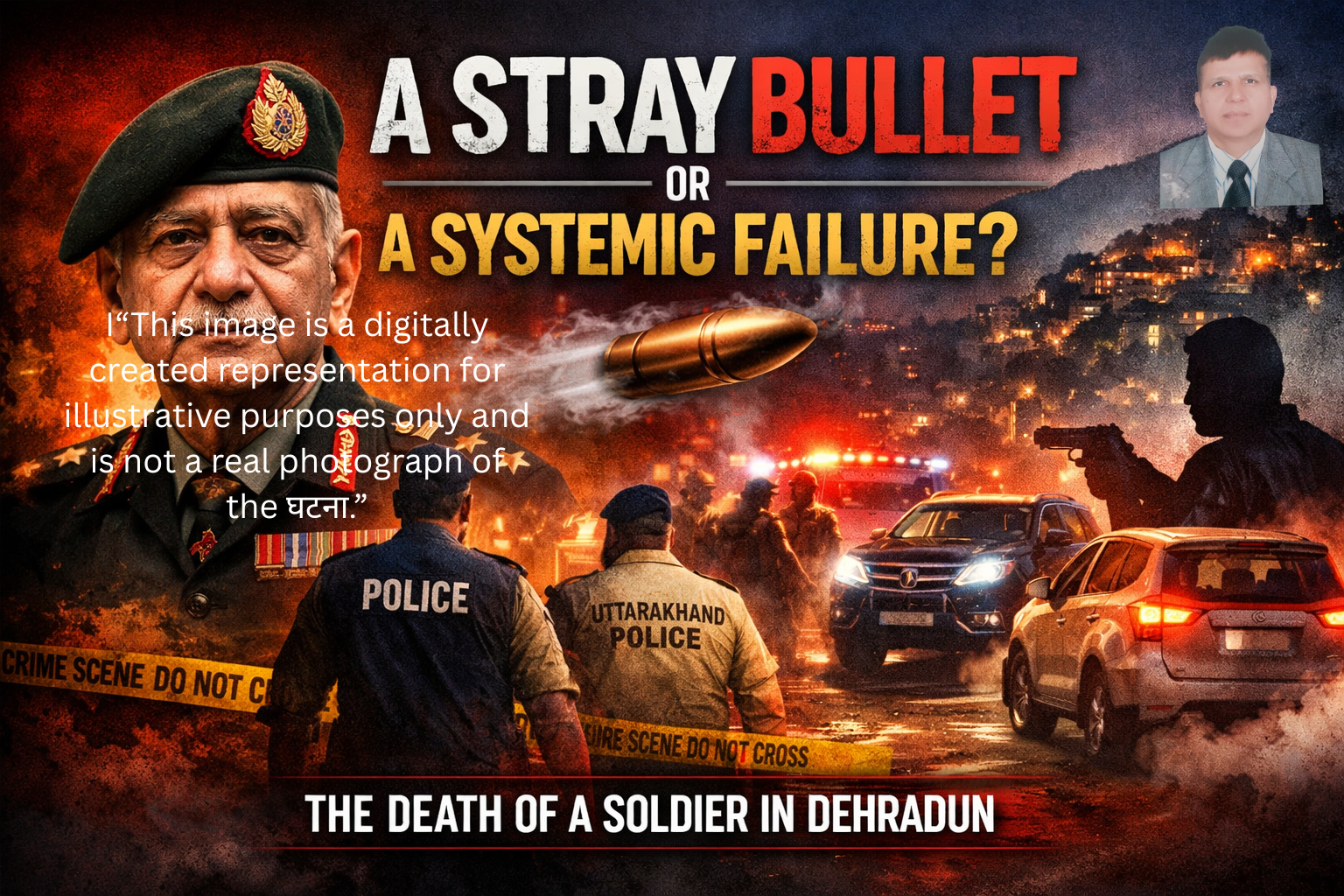


On the morning of March 30, 2026, Brigadier (Retd.) Mukesh Kumar Joshi, aged 74, stepped out for his routine walk in Dehradun. He never returned.
In Johri Village near Rajpur, a violent high-speed chase between two SUVs—a Scorpio and a Fortuner—ended in gunfire. The altercation reportedly began the previous night over a dispute at a nightclub involving loud DJ music. What should have ended as a minor disagreement escalated into a public shootout.
A bullet fired during this clash struck Brigadier Joshi, killing him instantly.
Police have since arrested four individuals. Vehicles have been seized. Others involved fled the scene. And the incident has been labelled—once again—as a “stray bullet.”
The phrase “stray bullet” appears neutral. It sounds accidental, almost unfortunate. But it is, in reality, deeply misleading.
Bullets do not become stray on their own. They are fired deliberately by individuals who feel no immediate fear of consequences. Calling it a stray bullet shifts attention away from the breakdown of law enforcement, the normalization of violent behavior, and the systemic gaps that allow such escalation. It converts a failure of order into an act of chance.
Over time, a certain social drift has taken root. Aggression is increasingly seen as masculinity. Loud, disruptive behavior is mistaken for authority. The idea of being “dabang” has acquired a misplaced sense of admiration. Silence in the face of such conduct is not neutrality; it is participation.
At the same time, the idea of a “Mitr Police” has evolved in a way that risks weakening deterrence. A citizen-friendly police force is essential, but friendliness cannot replace authority. Law enforcement must remain approachable, but also firm and clearly uncompromising when faced with violations. When the perception shifts toward softness, it creates space for recklessness.
A troubling pattern is also visible in regions like Uttarakhand, where visitors sometimes arrive not as responsible tourists, but as performers of dominance. Nightlife disputes spill onto public roads. Recklessness becomes a display of status. Tourism cannot be allowed to serve as a cover for behavior that disrupts the social fabric of a peaceful region.
Public discourse often compounds the problem. Instead of asking why firearms were used so casually or why escalation went unchecked, incidents are quickly reduced to labels such as “road rage” or “stray bullet.” This framing simplifies a systemic issue into a passing headline, allowing deeper concerns to fade from attention.
The core issue is not the absence of laws, but the absence of immediate and visible consequences. When enforcement is delayed, inconsistent, or unseen, law begins to feel optional rather than binding.
What is required is not merely reaction, but clarity and resolve. Enforcement must be swift and visible. Public spaces must operate under a clear zero-tolerance approach to violence. Every such incident should be followed by strong institutional messaging that reinforces the seriousness of consequences. At the same time, society must reconsider what it chooses to admire. Intimidation, noise, and aggression cannot be allowed to define public behavior.
The irony remains stark. A man who survived the battlefield lost his life on a peaceful morning walk. Not in war, not in defense of the nation, but in a breakdown of everyday governance.
This is not an isolated incident. When acts of violence are repeatedly reduced to convenient labels, the underlying problem remains untouched. A society that avoids confronting its everyday lawlessness will continue to lose its finest citizens—not to enemies, but to its own indifference.