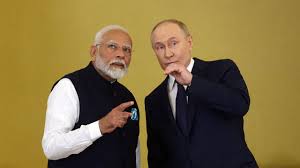
The second term of President Trump is marked by spontaneous, off-the-cuff remarks. To say he is an off-ramp in world politics would be an understatement — despite the possibility of his being nominated for the Nobel Peace Prize. Not because of the strength of his actions, but rather due to the iron grip the United States holds over global institutions that shape narratives and outcomes.
Trump’s tenure began with a deep political indebtedness to Elon Musk, forming a seemingly inseparable duo during the election run-up and immediately after winning. That bond fizzled quickly, but the damage was already done. His impulsive, late-night policy announcements, and tendency to treat complex geopolitical issues as solvable by maverick shortcuts or corporate deal-making, have proven disastrous.
That not even a single phone call was made to PM Modi during India’s Operation Sindoor is now a matter of record. So is the absence of any meaningful trade negotiations — replaced instead by a unilateral and “out-of-syllabus” tariff announcement of 25% plus 10% on Indian goods. His bizarre musings on Canada as the 51st US state, or careless statements on Greenland, Gaza, and Iran, only further position him as a reckless meddler.
While every sovereign nation has the right to set its immigration policy, Trump’s tendency to treat foreign leaders as pliable pawns is dangerous. He rarely dives deep into the realities of geopolitics, instead favoring flattery from weaker states led by authoritarian rulers with shaky public mandates.
In many ways, Trump personifies American arrogance. His public insult of President Zelensky — already besieged by war — for not wearing a suit at the White House was a moment that captured this. He assumes that economic strength equals moral superiority.
But recent comments that India and Russia are “dead economies” might go down as his most unserious moment yet. Compare that with Modi (11 years in power) and Putin (25 years), who never make a policy announcement without deep internal discussions. Ironically, this flippancy may end up helping India and Russia.
Sometimes, empires collapse under their own weight. The USSR didn’t just fall due to economics — it was also the incoming tide of transparency and connectivity that Gorbachev sensed, prompting glasnost and perestroika. In an ironic twist, America today faces a similar disruption, not from internal reformers, but from the unrelenting force of social media. Trump may well go down as the Gorbachev of the United States — a populist unable to control the digital tide that magnifies every contradiction, U-turn, and misstep.
Today, even in remote corners of the world, people dissect his policies within minutes. His trade wars with India are greeted with indifference, because India is no longer information-starved. Modi doesn’t need to bend — the digital public square has kept the country alert, assertive, and emotionally insulated.
Compare that to 30 years ago, when one narrative could dominate, and governments struggled to communicate with their people in real time. Today, the U.S. no longer controls the global narrative — every citizen, every device, is a node in the system. The myth of a single superpower shaping global thought is long dead.
Trump’s unpredictable outbursts present a golden opportunity for India and Russia to deepen their strategic and trade ties — and expose the hollowness of US foreign policy pragmatism. For Ukraine, the takeaway is even starker: NATO was only a fig leaf. The US’s real interest lies in its corporate and mineral gains and the obsession to undermine Russia.
As for Pakistan, long controlled by its military rather than its people, the IMF and World Bank loans it receives serve largely to keep it as a pawn in larger geopolitical games.
By clubbing India, Russia, and even Brazil under the same punitive tariffs — up to 50% — Trump may have unknowingly unified a new axis of cooperation. It’s time the world shows both Trump and the US their real place in a multipolar global order.
While it’s true that in geopolitics, there are no permanent enemies or friends, Trump has undeniably crossed a red line. And in doing so, he’s created a historic opportunity for India and Russia to revive and reshape their strategic partnership.
It should begin with a robust collaboration between Russia’s vast military-industrial complex and India’s Make in India program. While strategic ties with the US may continue, India and Russia — two nations with shared values, culture, and historical links — must seize this chance to reset their alliance.
After all, the day a true people’s government emerges in Pakistan, you could theoretically drive to Russia by car. The potential is real — and this might just be the inflection point that accelerates that future.